
In brief
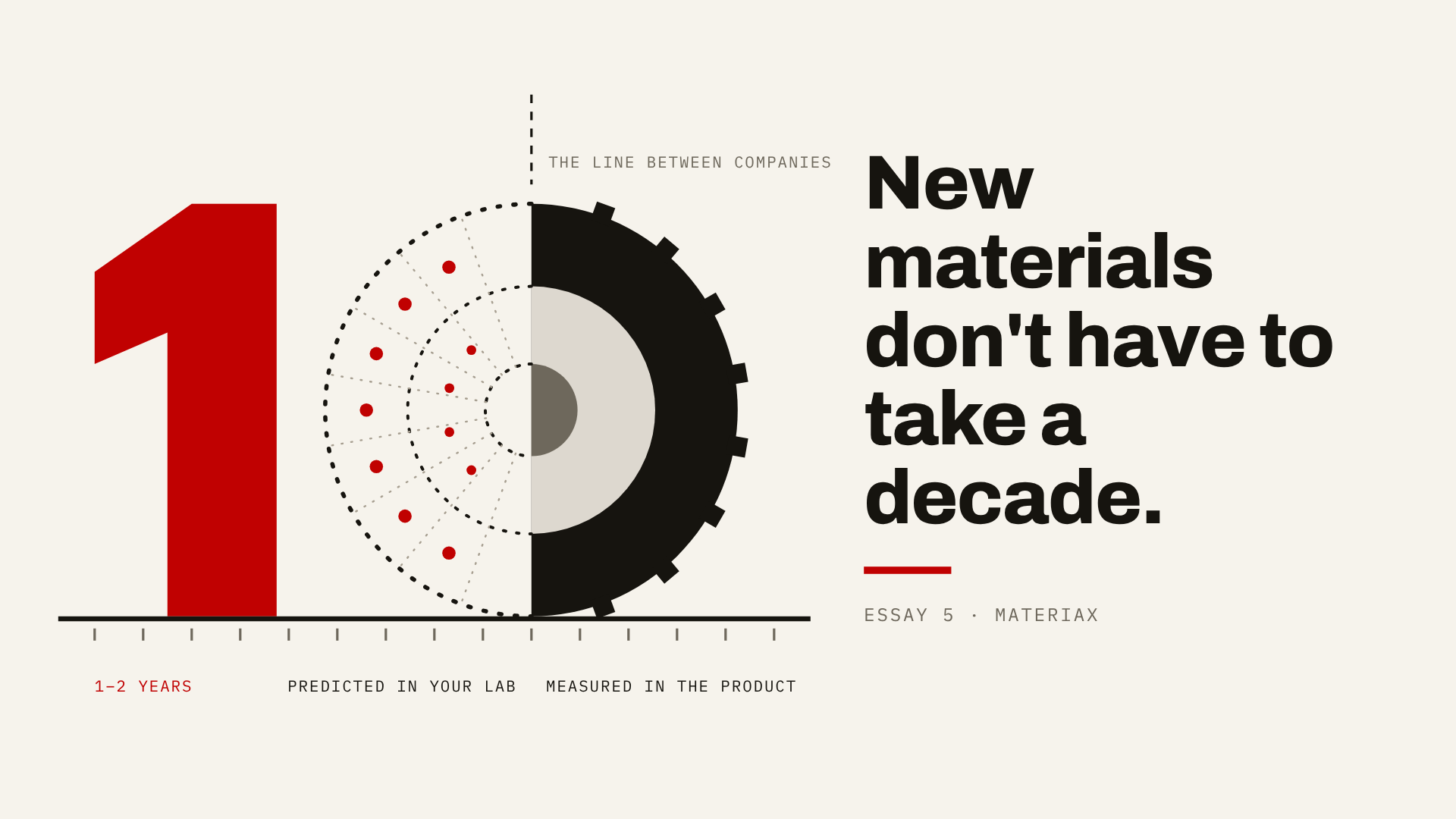
A new material takes ten years or more to get from the lab into a product. I think it can take one or two. I have just published a paper that shows how, and this essay explains it without the math.
Most of those years are not spent inventing the material. They are spent at the customer, who has to build each new sample into a real product, a tire or a battery cell, and test it, round after round. AI and robots are making the materials lab ten times faster, but they do not shorten those rounds, so a ten-year program still takes about seven.
The paper sets out a way to cut the rounds themselves. The supplier builds small-scale tests of the customer's product in its own lab and uses AI and robots to learn there which materials will work. It takes a set of tests, not one, because a product has to meet several requirements at once. Supplier and customer then exchange predictions, not recipes or product data, and decide together which product to build next. The trade is more testing inside each company, done by AI and robots, for far fewer products built and tested at the customer. The method builds on Minimum Knowledge Collaboration, or MKC, the rules I proposed earlier for how companies can develop a product together without opening their books. This is its second version, so I call it MKC2. In computer simulations of companies developing a product together, the customer had to build and test 2 products instead of 35 to get one that was good enough, and with four companies in the chain, 1 instead of about 30. A ten-year program becomes about two years the first time and close to one after that.
This is the fifth essay in a series that began with a number I have lived with for my whole career. A new material takes ten to twenty years to reach a product. The cathode material of the first lithium-ion batteries was invented in 1980 and reached cars at scale in the 2010s. As chief technology officer of Cabot, a materials company, I gave boards the usual reasons: the science is slow, scale-up is hard, qualification cannot be rushed. None of them explains the number.
The years go into the hand-offs between companies. A supplier proves its material in its own lab. The customer cannot commit on that evidence, so it tests again in its own product, and then its customer does the same. I have been part of more than a hundred joint development programs, in which a supplier and a customer agree to develop a product together. Only twenty or thirty delivered what they were signed to deliver, and very few of the failures were failures of the material. Most ran out of patience. The supplier sent one more sample, the customer replied with little more than better, same or worse (we called those replies smiley faces), and eventually someone senior said enough.
The earlier essays took that problem one piece at a time. The third proposed rules that let companies share just enough to keep learning from each other, without giving away recipes or data. I call them Minimum Knowledge Collaboration, or MKC. The fourth showed why AI in the lab does not shorten the program by itself: it is horsepower for a car stuck in the mud. This essay puts the pieces together. It is based on a paper I have just posted on ChemRxiv, the chemistry preprint server, which works out the method step by step and then tests it in simulation. The link is at the end.
One or two years is a bold claim, so here is what has to happen. Each company has to test much more in its own lab before it sends anything, and not on the material alone: on small-scale tests of the product, several of them, because performance, durability and safety have to hold together. That is more testing than a materials lab runs today, and it is the work AI and robots should be doing. The companies also have to share a little more, in a controlled way, so that what each learns at home still predicts the real product. In return, the customer builds and tests far fewer real products.
AI is making the wrong part faster
Everyone is putting AI and robots into the materials lab, and the lab really is ten times faster. The fourth essay did the arithmetic. Take a ten-year program with three years of work at the supplier and seven at the customer. Make the supplier ten times faster and the program still takes more than seven years. We are speeding up the work on the material, and the customer is waiting for something else: to learn whether this material works in its product.
Each company builds small-scale tests of the product
Every sample sent to the customer is a question the supplier could not answer in its own lab. To send fewer samples, the supplier has to answer more of those questions at home. The tool for that is what I call an application proxy: small-scale tests that stand in for the customer's product, built in the supplier's own lab. They do not use the customer's ingredients or data. The supplier picks ordinary ingredients to stand in for them and chooses its own test conditions. It is the supplier's own test track, a place to find out how a material behaves in the product before the customer builds anything.
There is no one magic test. A product has to meet several requirements at once, and they often pull against each other. A tire has to grip in the wet, waste little fuel and last. A battery cell has to store energy, survive thousands of cycles and stay safe. Improve one and another usually gets worse. So an application proxy is a set of tests, each built to show one way the product can fail, and they are read together to judge the overall balance.
Every materials company already has tests like this. Cabot makes carbon black, the powder that reinforces the rubber in tires. We tested it in standard rubber recipes, and a strip of rubber the size of a stick of gum told us a great deal about how much fuel a tire would waste. It told us much less about wet grip and nothing about wear, which need tests of their own. At Group1, the battery company I co-founded, we went from coin cells to pouch cells to full-size cylindrical cells before a cell maker would take our results seriously. Tests like these used to be too slow and too limited to answer the questions customers ask. AI and robots can change that, if we use them to run these tests and not only to make new materials.
Sharing just enough
A supplier's small-scale tests are only useful if they predict the real product, and the supplier cannot check that alone, because the real product belongs to the customer. Each company also chooses alone. A supplier sends the material that looks best in its own tests, without knowing which design the customer will pair it with.
So the companies have to share something, and the question is how little. MKC was my answer to that question. The new paper extends it to the small-scale tests, and I call the extended version MKC2. The supplier sends short predictions of how each new material will perform, not its recipes, test data or models. The customer compares those predictions with how its real products perform, corrects for the difference, and keeps its own results to itself. A neutral coordinator, which can be software both sides trust, then picks which of the supplier's materials to try with which of the customer's designs, looking at every requirement at once. In place of a smiley face, the customer's reply tells the supplier which requirement is holding the product back, and under what conditions, so the supplier knows what to test next.
The companies agree on all of this before the first test, in their joint development agreement, the contract that governs the program: what each side sends, what comes back, and who keeps what. The customer gets candidates already checked against its requirements. The supplier gets feedback it can use. Neither gives away the know-how that makes it worth working with.
Three steps: build the tests, train the model, choose together
The paper sets out how to do this in practice, in three steps.
The first step is building the right tests, and that is engineering work. Start from the requirements the product has to meet at the same time. For each one, choose the stand-in ingredients, sample shape and test conditions that show how the product fails on it. Every test has one hard rule: it has to show the problem that will make the product fail. The rubber strip ranks tire rubbers by how much fuel they will waste, but it says nothing about wear, because wear happens where the tire meets the road. Two rubbers can behave identically in the strip and wear very differently on the road, and no amount of extra data from the strip will tell them apart. Only a second test, built for wear, will. This is where I would spend the first dollar of any AI budget in materials.
The second step is training the model, and this is where AI and robots do most of the work. Robots run the tests under many conditions, with many stand-in ingredients in place of the other companies' own. That is far more application testing than a supplier does today, when a new material is often checked in one standard recipe under one set of conditions. The model learns from the full measurement curves of all the tests, not one number per sample, and it has to predict every requirement together, because a material that wins one test and fails another is no use. Product tests at the customer then correct it wherever it is off. In the simulations, each extra batch of lab tests reduced the number of products the customer still had to build, until about one was enough. That tells a team when it has done enough lab work.
The third step is choosing together, and this is where the program gets shorter. On a new program, each company measures its new materials in its own lab first and sends only predictions. The coordinator picks the combination most likely to meet every requirement. The first product the customer builds is no longer a guess. It checks a prediction, and each result improves the model for the next one. The model stays with the company that built it and carries over to the next program, which is why the second program goes faster than the first.
The three steps also show what to fix when results disappoint. If two materials look the same in the lab tests but behave differently in the product, a test is missing. If the tests show the difference but the model predicts it poorly, the model needs more training. If the model ranks the right combination first and nobody builds it, the companies need to change how they choose.
Testing the rules before using them
Economists call this kind of problem mechanism design: setting the rules for what parties with private information may tell each other, so that together they reach a good outcome. It won Leonid Hurwicz, Eric Maskin and Roger Myerson the Nobel Prize in 2007. Economists test new rules in computer simulations before anyone uses them with real money, and the paper tests MKC2 the same way.
Each company is a piece of software that acts on its own, with materials only it knows, a private lab and its own small-scale tests. A product is scored by its weakest requirement, the way a tire with brilliant grip and poor wear is a poor tire. The simulation counts every lab test and every product the customer builds. It compares MKC2 with MKC alone, the earlier rules without the small-scale tests, on the same programs and with the same goal: a product at least 90% as good as the best one the companies could have made.
What the simulations showed
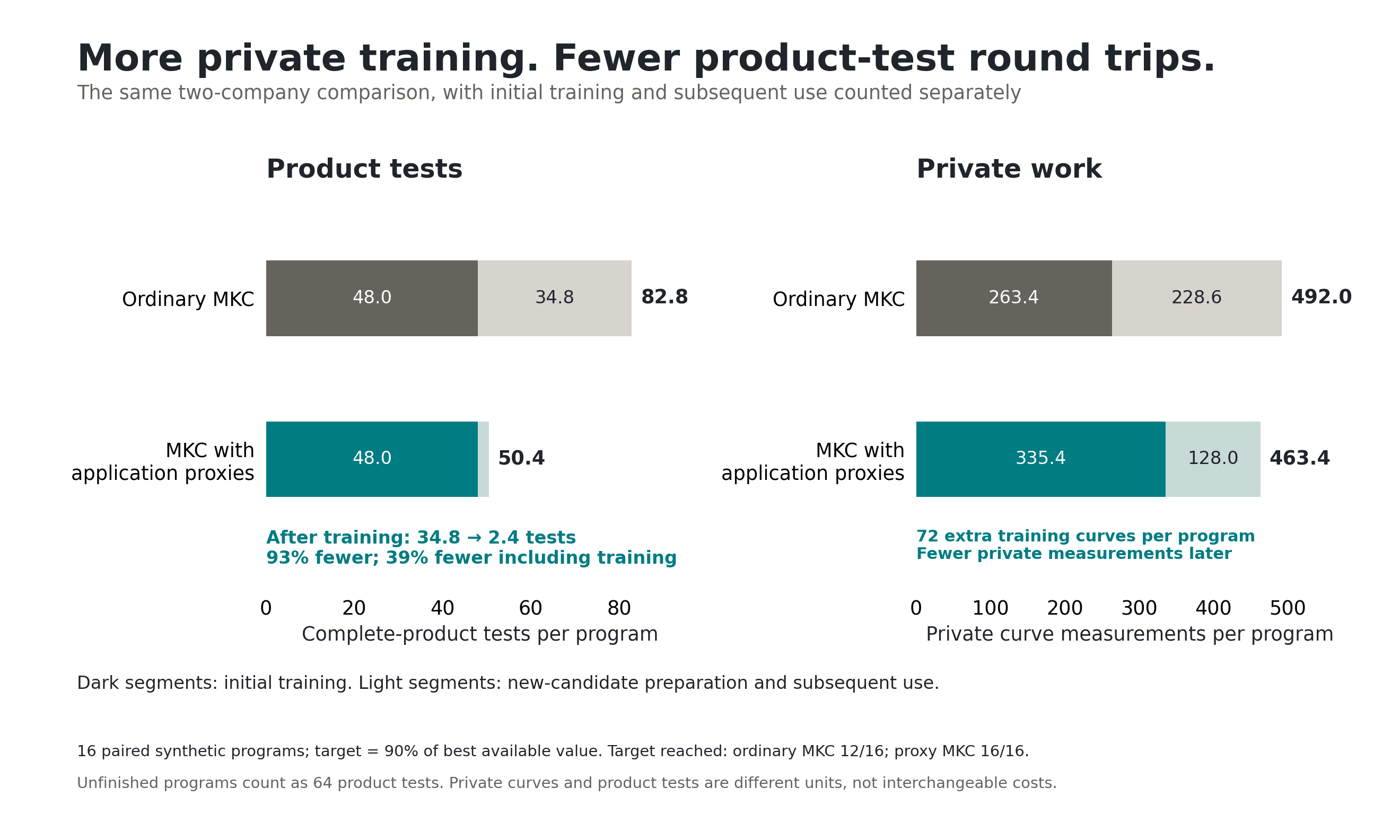
The number of products the customer had to build and test fell more than tenfold. On a new program with two companies, MKC alone needed about 35 products to reach the goal. MKC2 needed about 2, and every program got there, where one in four had fallen short. With four companies, about 30 became 1: the first product the customer built met the goal every time.
None of this is free. The suppliers tested more at home. With two companies, each program took 72 extra lab measurements up front to train the models, and every new material was measured in the supplier's lab before the customer built anything. The trained models then made some later lab tests unnecessary, so the total lab work came out about the same. With four companies it rose by about two hundred measurements per program, roughly a fifth, and that bought some thirty fewer products built.
That is the trade the paper counts: lab measurements on small samples, which robots now run around the clock, against products that each need a slot on the customer's line and weeks or months of testing. Counting everything, including the product tests that trained the models, the customer still built almost 40% fewer products.
I was surprised by what did the work. A more accurate model barely changed the result. Choosing together did. When each company could put forward only its own favorites, the same predictions needed five times as many products built. A good model is wasted if nobody builds the combination it recommends.
From ten years to one or two
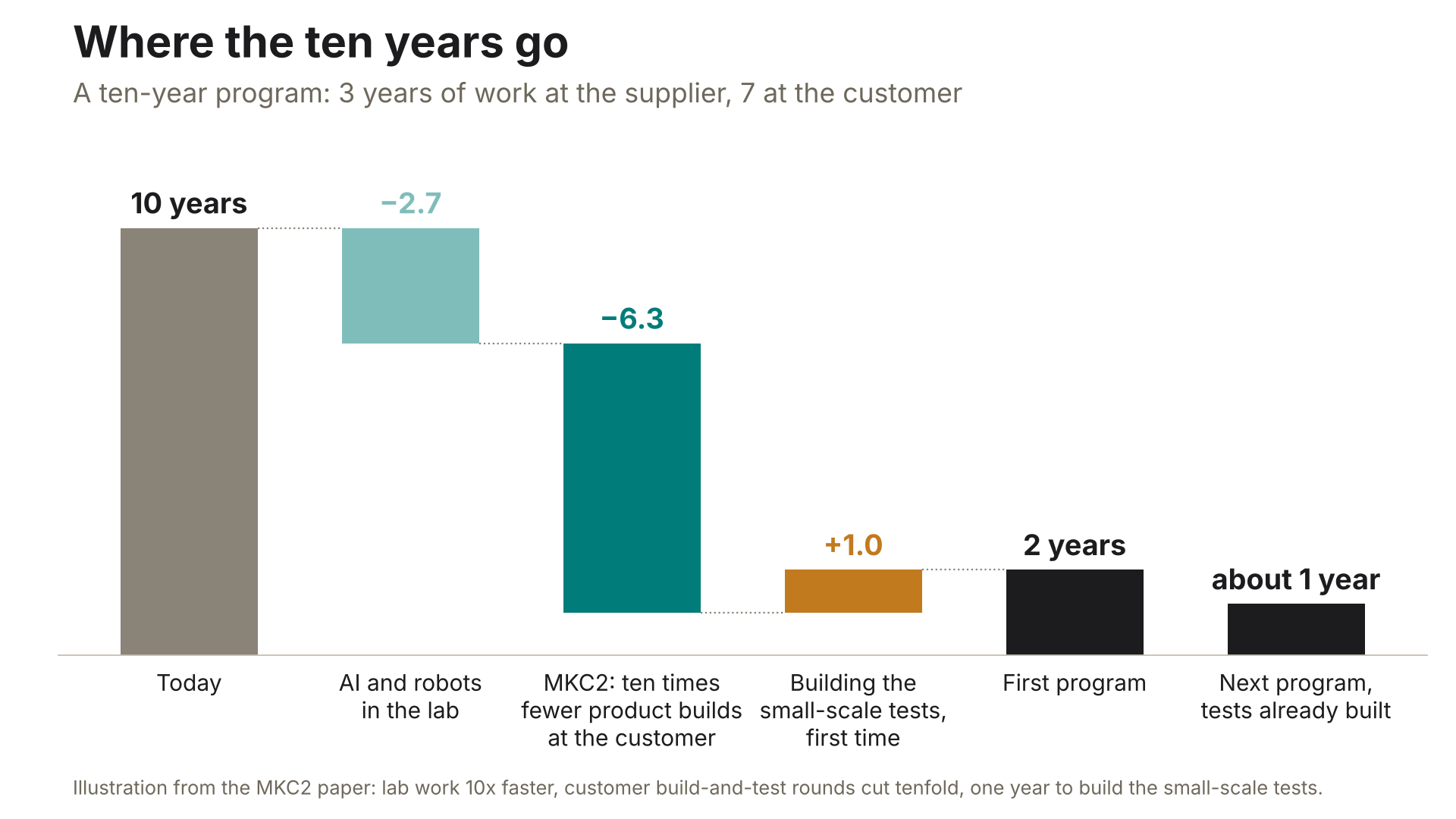
Go back to the ten-year program, with three years at the supplier and seven at the customer, and add up what each change contributes.
AI and robots in the lab cut the supplier's three years to a few months, which saves less than three years. MKC2 goes after the other seven. Cut the customer's build-and-test rounds tenfold, as in the simulations, and seven years at the customer shrink toward one. Building and training the small-scale tests the first time adds about a year back. The first program takes about two years. On the next program the tests and models already exist, and it takes closer to one.
Some steps take the time they take. A cell still has to age, a tire still has to run, a regulator still has to review. But they start with a candidate already checked against the product, and far fewer programs end with another round of samples.
What the five essays add up to
The ten to twenty years this series started with were never set by chemistry. They are the cost of working across company lines, paid one sample and one smiley face at a time.
It has taken five essays because the pieces only work together. Rules for sharing, without small-scale tests in each lab, still leave the customer building product after product: MKC alone needed about 35. Small-scale tests without the rules cannot be checked against the real product, and each company goes on choosing alone. AI without either one makes the fast part of the program faster. With all three, AI in materials delivers on its promise: a faster lab, and far fewer products built and tested at the customer.
The next step is a real supplier and a real customer. Most pairs already hold what a first test needs: past candidates, lab measurements and product results from programs they ran together. That history can build a first model and show, without a single new experiment, whether it would have chosen better. I am building this at MateriaX, and I am looking for the first supplier and customer willing to try. If you run joint development on either side, write to me.
The paper is “Unlocking the promise of materials AI through application proxies and protected collaboration,” on ChemRxiv: https://doi.org/10.26434/chemrxiv.15011951/v1. It sets out the method in full, from building the tests to choosing together, with the simulations that test it. You can also walk through the three steps and watch the simulations run, one product at a time, at https://materiax.ai/mkc/application-proxies/.
The series
Essay 1. Why materials take decades to be adopted: https://materiax.ai/essays/why-materials-take-decades-to-be-adopted
Essay 2. Why joint development usually fails, and how to run one that does not: https://materiax.ai/essays/why-joint-development-usually-fails
Essay 3. What if joint development had a protocol, like the internet? https://materiax.ai/essays/what-if-joint-development-had-a-protocol
Essay 4. Materials AI is buying horsepower for a car stuck in the mud: https://materiax.ai/essays/materials-ai-horsepower-car-stuck-in-mud