
MateriaX · Senior technology leadership for materials-driven companies
Materials. Products.
AI. Connected.
I'm Dr. Yakov Kutsovsky, former CTO of Cabot Corporation, co-founder of Group1, and Expert-in-Residence at Harvard. I help companies get new materials from lab breakthroughs to profitable production and new applications.
Deep enough to understand the technical work. Experienced enough to see how product, process, and company choices affect one another. Close enough to the work to help the company act.
Judgment built at industrial scale. Applied with startup speed and agency.
Long-term advisor · Board director or advisory-board member · Fractional CTO or CSO
The decisions are connected. The work should be too.
In tires, batteries, coatings, and other performance products, the material is only one part of the system. Multiple materials, interfaces, components, and processes must work together. Improving one can change performance, manufacturability, cost, or qualification elsewhere. I help companies resolve those tradeoffs across the full system.
At Cabot, I worked across materials, process, manufacturing, product performance, and customer requirements. At Group1, I worked across cathode materials, electrodes, and cells while scaling cathode production from laboratory synthesis to pilot scale. The scale was different, but the responsibility was the same: make the whole system work.
Five questions I help companies work through.
/Which product and application should we pursue first?
A strong material may fit several markets, but the first application shapes product design, the qualification path, partners, capital needs, and time to revenue. I look for a customer problem worth solving, a performance gain that matters, willingness to pay, and a credible path to adoption.
/What else has to work in the complete product?
A material advantage has to survive in the complete product, not only in a material test. I help teams identify which interaction limits performance and what to change next.
/What will change at scale and during customer qualification?
At larger scale, equipment geometry, operating conditions, and process control can alter mixing, heat transfer, and mass transfer. That can affect yield, consistency, safety, and cost. Customer qualification exposes conditions the lab may not reproduce. Either can require changes to the material, process, or product design.
/What must we own or control, and where do we need partners?
The company must decide which materials, processes, data, know-how, capabilities, and rights it must own or control, and where a partner can add speed or capability. Patents, trade secrets, data rights, licenses, field-of-use provisions, and development agreements allocate ownership, access, and control in different ways.
/How can AI and materials informatics change materials and product development?
AI can broaden the possibilities a team can examine and change how the company learns across materials, products, and customers. The right starting point depends on what the company is building and the capability it already has.
A change in one answer can reopen the others as the product, evidence, and company evolve.
Where technical possibility meets commercial value
Materials. Processes. Product architectures. What could work.
Applications. Customers. Economics. What creates value.
Experience and judgment determine what to pursue, prove, protect, and scale. The X in MateriaX is where what could work meets what creates value.
AI expands what companies can learn, build, and bring to customers.
In many materials companies, experimental results, plant data, product performance, customer feedback, IP, and economic assumptions sit in different systems and teams. That data and context are hard to use together. AI can make individual tasks faster. The step change comes when a company can explore paths that were previously impractical and carry learning from materials and processes into products and customers.
Examine more possible paths
Teams can examine more materials, formulations, process conditions, product architectures, and commercial paths. AI can connect experimental results with product performance, customer needs, manufacturing constraints, IP, and economics, so each program builds on more of what the company already knows.
Build a company capability, not a tool collection
The foundation is usable data, context that preserves what each result means, and workflows that connect where knowledge is created and used. The company can then choose the models, knowledge graphs, and agents suited to the work, with validation, privacy, access, traceability, and ownership designed in from the start.
Experience behind the approach
At Cabot, I led the design and implementation of a global materials-informatics system across five technology centers. At Group1, we built AI and materials informatics into materials and battery development and scale-up from the beginning. I now serve as Senior Advisor to Uncountable.
How I use these systems now
I use AI models and agents in my own technical and strategic work to draw on more data and context and build technical, IP, financial, and computational models. That keeps my advice grounded in what these systems can do, what they require, and where new evidence must still be created.
The measure is not the number of AI tools deployed or tokens consumed. It is whether the company learns faster and turns more of that learning into products customers value. Technical claims must still hold in experiments, manufacturing, products, and customer use.
Where I have the highest impact.
Materials and hardtech startups need industrial-scale experience without corporate drag. Established companies need startup speed and agency without losing rigor. Boards need independent technical judgment when technology shapes growth, risk, and capital.
Materials & hardtech startups
I work with founders who have a real technical result but still need to choose the first market, prove value with customers, define the scale path, or decide what the company must own.
How I help materials and hardtech startups
I help the team turn those decisions into a materials and product development path it can execute. For AI-first ventures, I help build the capability in from the start.
How I work →Mid-sized companies whose future depends on materials
I work with specialty-materials companies and manufacturers of batteries, cells, coatings, and other advanced products deciding whether a materials or product platform deserves the next major commitment.
How I help mid-sized companies
I help the CEO and technology team connect product proof and R&D priorities to manufacturing, qualification, IP, partners, and investment. Where AI can change development, I help decide what to build or redesign, not simply automate.
How I work →Boards overseeing technology-led growth
I work with boards evaluating major capital commitments, acquisitions, first plants, or technology-led growth plans.
This draws on five years as a board director.
How I help boards overseeing technology-led growth
I test the product, manufacturing, partner, and organizational assumptions behind the plan. I ask whether the evidence supports them, whether the expected value justifies the capital at risk, and whether the company can execute. For AI, I test whether the ambition fits the strategy and operating capability, whether the investment is supported by evidence, and whether governance protects company knowledge.
Board service →
 florrent

 Modern Hydrogen




The startups shown here have publicly disclosed these relationships. My work with them has included first commercial launches, first-of-a-kind materials and cells, first-of-a-kind process scale-ups, and decisions at manufacturing scale. Two advised companies received more than $34M in ARPA-E SCALEUP awards. My work with established chemical and specialty-formulation companies is generally private under NDA.
I stay with the work.
Decisions change as new evidence appears during execution. I stay close through that process, which is why I prefer long-term engagements.
I judge my contribution by impact, not by advice delivered. In fractional roles, that includes shared accountability for delivery. In board and advisory roles, it means sustained attention, candid challenge, and independent judgment within the authority of the role.
I coach leaders and mentor technical teams as we solve the problem, building judgment and capability that remain inside the company.
Long-term advisorIndependent judgment without executive authority
Role in practice for a long-term advisor
Board director or advisory-board memberTwo formal roles with different duties
Role in practice for a board director or advisory-board member
Fractional CTO / CSOEmbedded executive technology leadership
Role in practice for a fractional CTO or CSO
It starts as a conversation,
not a contract.
We begin with the company, not a service package. We talk about the technology, team, ambition, and issue that matters now. I can share relevant examples in that first discussion.
If I am not the right person, I will say so and point you elsewhere. If we continue, I learn how the company got here, meet the team, and test the key assumptions.
The right role becomes clear through these conversations.
Conflicts & confidentiality
I check for conflicts before sensitive information is shared. Confidential work begins under agreed terms, typically a mutual NDA for advisory work, and I keep each client's information separate. We agree in advance whether any outside system, including an AI service, may receive company information and under what safeguards. Board appointments follow the company's governance, conflict, and confidentiality requirements.
Judgment comes from experience.
This is where mine was built.

I'm Yakov Kutsovsky. I've spent 35 years taking new materials from grams in a lab to tens of thousands of tons across commercial sites, while building the teams, IP positions, and businesses around them.
Built at global scaleCabot CTO and CSO · 15 years · 350-person global R&D
At Cabot Corporation, I served as CTO and Chief Scientific Officer for 15 years and led a 350-person R&D organization across five global technology centers. My work spanned tires, batteries, displays, inkjet printing, coatings, adhesives, sealants, and plastic composites. I built global collaboration programs with leading customers and partners that led to new products and technology licensing. I also identified and executed multiple M&A opportunities that expanded Cabot's technology portfolio.
As President of Applied Nanostructured Solutions, I held responsibility for operations and capital projects. We tripled capacity and expanded the opportunity pipeline fivefold.
Startup speed and agencyGroup1 co-founder · five years as CSO · laboratory to pilot
I co-founded Group1 and served for five years as Chief Scientific Officer, leading materials and battery development, process scale-up, and IP strategy.
Group1 began with the idea and first KPW paper from Professor John Goodenough's laboratory at UT Austin. Co-founder Leigang Xue invented the cathode there. We secured exclusive technology rights, moved KPW production from laboratory synthesis to pilot scale, and developed what Group1 announced as the world's first 18650-format potassium-ion cell, using graphite as the anode. We also secured $1.5M in NSF STTR and SBIR funding. Group1 taught me how quickly strategy turns into decisions about hiring, experiments, partnerships, and capital.
Current workMateriaX · Harvard · advisory, board, and fractional leadership
As an Expert-in-Residence at Harvard, my research with Zhigang Suo's group has produced seven publications from 2023 through 2026, including work in Nature, Nature Sustainability, Nature Communications, and PNAS.
Through MateriaX, I advise founders and CEOs, serve as a fractional CTO in private chemical and specialty-formulation companies, and take board or advisory-board roles when the mandate fits. My board work draws on five years as a director. Across these roles, I stay close enough to test assumptions and work through disagreement. In executive and advisory engagements, I also follow decisions into execution.
Work you can inspect.
Public evidence of how I think and work: industrial presentations, practical frameworks, and peer-reviewed research.
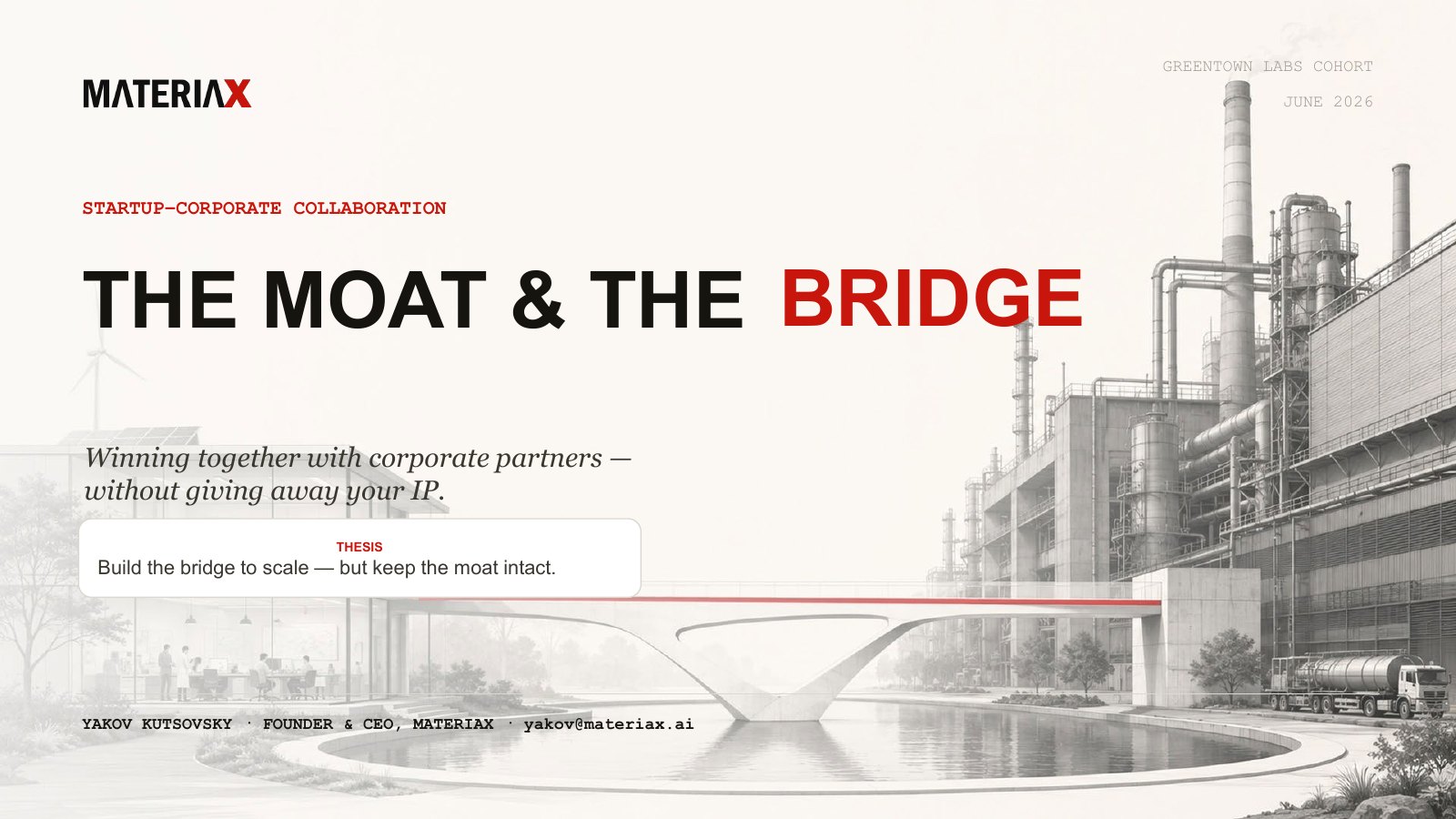
The Moat & the Bridge
How startups work with corporate partners without giving away their future. Partnership structure, proof-of-concept design, and NDA/JDA terms determine who owns what comes next. Taught at Greentown Labs and used in client work.
View the presentation →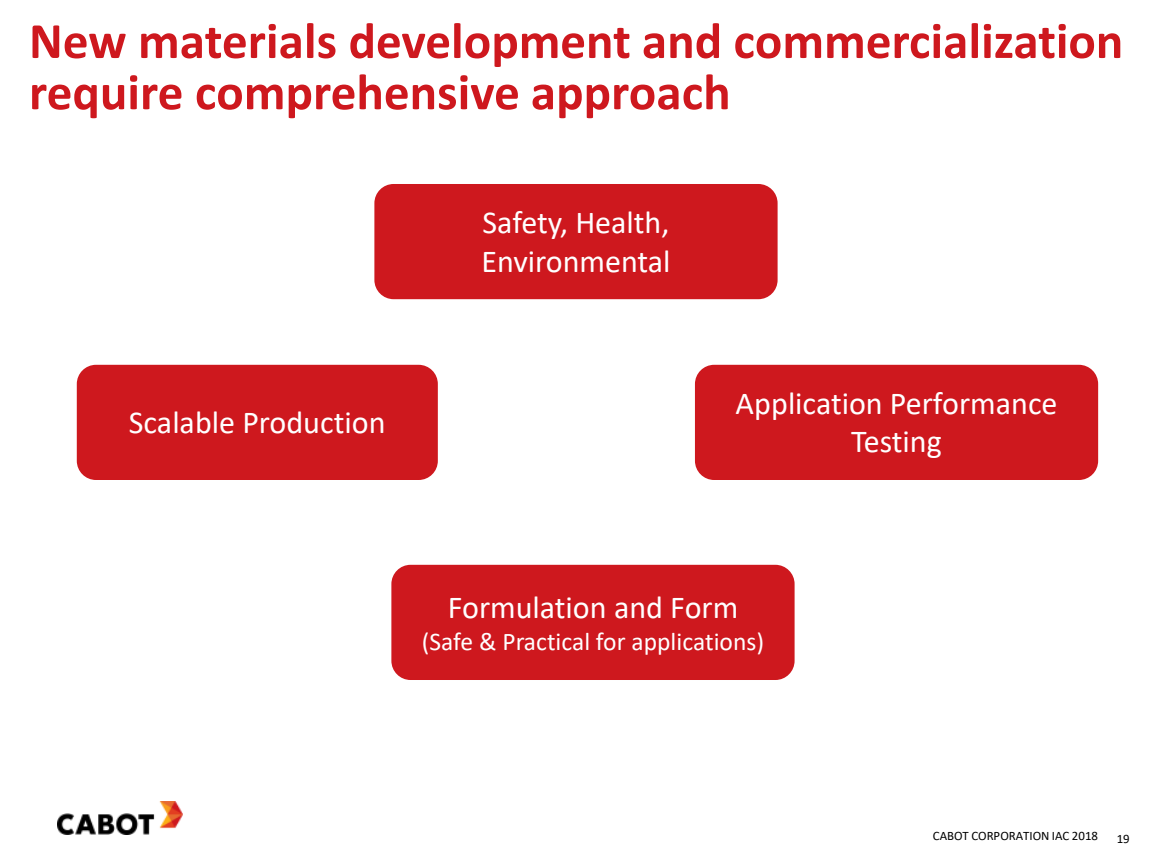
Industrializing performance materials
The deck shows how application requirements, product-by-process design, computational modeling, scale-up, formulation, safety, and cost were treated as one commercialization problem across carbon black, fumed oxides, inkjet colorants, aerogels, battery materials, and advanced composites.
View the presentation →Research in the news · Harvard SEASNature, PNAS, and video
Harvard SEAS · The PNAS tire-composite work (2026)
Harvard SEAS · The Nature fatigue-resistance work (2023)
Essays land on LinkedIn first. Follow on LinkedIn ↗ · Public record: publications & patents →
Tell me what you're trying to build or decide.
A short note is enough. Tell me what you're building, the decision ahead, and why it matters now. I read every note myself and respond within two business days. I take on a small number of engagements, so fit matters.