
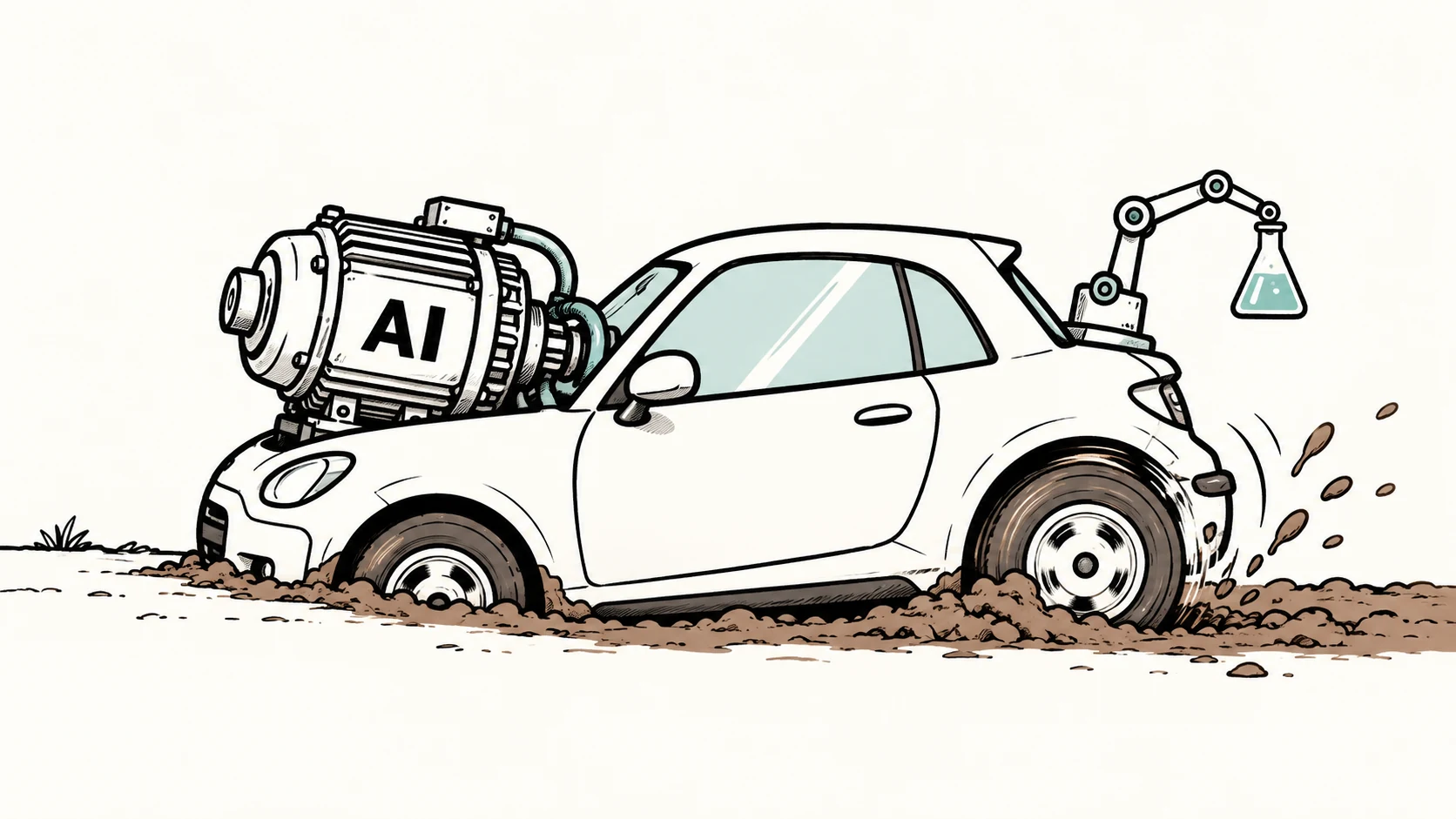
Picture the driver flooring it. The engine roars, mud flies, and the car sinks a little deeper. From the far side of a company boundary, that is what a faster materials lab can look like. Robots make and test compounds around the clock. Models propose new structures by the million. The customer still needs to find out whether the material works in its product.
The arithmetic is unkind. Take a ten-year program with three years of supplier work and seven in customer trials, redesign and qualification. Make the supplier’s work ten times faster and the program still takes more than seven years. The robot has done its job. Much of the development calendar has barely moved.
I would put more of that horsepower into something materials companies already use and few people find exciting: the application proxy. This is a physical test or test assembly that reproduces selected conditions of the customer’s product inside the supplier’s lab. The better it predicts which materials will work, the more development the supplier can do before asking the customer to build again.
When a good lab result meets the real product
At Cabot we tested carbon blacks in standard rubber compounds. We could explain almost everything about a grade in those compounds, and much less about why one of them won in a tire. The compound was something we could make and test ourselves. The tire brought together other materials, manufacturing choices and a design we did not control.
A useful tire proxy fits in your hand. Drop a rubber ball. Some energy comes back as bounce; some turns into heat. A laboratory measurement called tan delta describes the balance between energy loss and elastic storage. A strip of rubber the size of a stick of gum, flexed under suitable conditions, helps rank tread compounds for rolling resistance long before anyone builds a tire.
That little strip carries real physics. A rolling tire repeatedly deforms its rubber, and the energy lost as heat has to come from somewhere. For the driver, it comes from fuel or the battery. The supplier can study an important part of that behavior without owning a tire factory.
But the same measurement is a weaker guide to wet grip. When we studied wet skid at Cabot, the worn surface and the water between rubber and road mattered as well as the bulk rubber. And flexing a strip is not a wear test. Wear involves abrasion and tearing at a surface, under slip and road contact that the flexing test does not reproduce.
The tire has to meet all three requirements together. Better grip is not much use if the tread wears out too quickly or wastes too much energy. This is where the apparently simple idea of a proxy becomes demanding: it must help us find a material that resolves competing requirements, not just wins one laboratory contest.
A material can pass its laboratory tests and still fail in service. Solar-module backsheets provide a costly example. Polyamide backsheets used in solar modules passed qualification, then cracked in the field. Researchers reproduced field-like cracking by combining light, heat, humidity and mechanical stress. The laboratory had to reproduce what happened to the material on the roof.
How much of the application should a supplier bring home
At Group1.ai as all in battery space we started with coin cells. They told us a lot about the cathode and much less about a practical battery. Pouch cells came next. To produce evidence a cell maker would take seriously, we built full 18650 cylindrical cells. Each step captured more of the application and cost more to run.
The decision was not simply to make a larger specimen. It was to bring more of the questions we needed to answer into our own development work. A cell with a strong first cycle still has to survive repeated charging, temperature changes and aging. Energy, power, life and safety have to hold together. A larger cell tested under the wrong conditions can still be a poor proxy.
The first essay in this series asked how a promising material crosses company boundaries to become a successful product. A cathode company builds cells because that is where its material has to prove itself. But how far should it go? Following that logic into commercial cell manufacturing brings factories, capital needs and responsibilities well beyond making test cells.
A supplier can reproduce the parts of the application it needs to understand without taking over the whole business. Making test assemblies to develop a better material is a different investment from manufacturing the customer’s product for sale.
The investment question is practical: which additional experiment in the supplier’s lab would prevent another expensive round at the customer?
Giving AI something worth learning
Inkjet makes the problem easy to picture. An ink waits in a bottle, accelerates through a nozzle, breaks into drops and dries on a surface. A viscosity value cannot describe that whole journey. Polymer inks with similar viscosity can form different drops because their chains stretch and relax differently. A useful set of tests follows enough of that journey to explain why one formulation prints well and another does not.
The physical proxy produces measurements along that journey. The model learns from them to predict what another formulation will do and choose the next experiment. A large model trained only on a test that misses the cause of failure cannot recover the missing physics by itself.
AI and robotics can make this kind of investigation much more practical. A supplier can explore reference formulations, processing settings and service conditions that would be slow to cover by hand. For a carbon-black supplier, that could mean different polymers, curatives and mixing conditions. The model helps choose a formulation and the test most likely to explain its behavior.
Those reference ingredients stand in for materials supplied by other companies. They do not reproduce every customer formulation. They let the supplier learn how its own material behaves across a range of plausible combinations, instead of becoming exceptionally good at one standard recipe.
Once the tests reproduce the behavior that matters, there is more to learn from them than a single score. A stress–strain curve tells us how a material changes as it deforms, not only the load at which it breaks. Early battery charging and discharging curves have helped researchers predict later cycle life. These records can reveal why two candidates with the same headline number behave differently in use.
The conditions still have to be right. In polyethylene pipes, researchers found that hot-water aging reproduced chemical changes seen in service, while hot-air aging followed a different path. Heating harder is not automatically a faster route to the right answer.
The progression I have in mind starts with a useful measurement, expands to several requirements tested together, and builds a predictive model of how they change through processing, use and age. An application-specific digital twin is a possible result of that work. It earns the name by predicting physical behavior that someone checks, not by being a detailed picture on a screen.
Sergei Kalinin and colleagues make a useful distinction in their recent paper on dual digital twins. They pair a model of the material’s response with a model of what the instrument can measure or change. Both guide the next experiment. For a supplier, developing a better application proxy often means developing a better test: one that captures more of what matters in the customer’s product. The model can only learn from the behavior the test reveals.
That model is worth carrying into the next customer program. It gives the supplier a way to choose materials using what earlier experiments taught it, rather than starting with another folder of results to interpret. The first program pays for some of the learning. Later programs should benefit from it.
The customer still knows something the supplier does not
The next customer, however, brings a formulation, manufacturing process and product design the supplier has not reproduced exactly. A material that works in the supplier’s reference system can disappoint in that combination. Comparing product results with its own predictions helps the supplier learn where the proxy fails and what to test next.
Better, same or worse is useful feedback, but it can leave months of work unexplained. Did the material fail because of its own properties, the ingredients around it or the way the product was made? A supplier can run many more experiments without knowing which of those questions to pursue. After years of smiley faces, I want a reply that helps me decide what to test next.
There is more than one way to get there. A supplier and customer can develop a common test method, agree on reference formulations, or work together on the experiments that connect laboratory results to product performance. A shared application lab can bring the two teams closer to the same evidence. The right arrangement depends on what they can share, what they need to protect and who can afford to run the tests.
Minimum Knowledge Collaboration, or MKC, is the computational route I introduced in the previous essay. Companies share limited descriptions of the options they can make, use product results to choose combinations, and receive guidance for their next experiments while keeping detailed recipes and models private. It provides a way to coordinate the learning when opening the books is not an option.
The next version, MKCv2, explores how that exchange can help suppliers build and retain better application-proxy models. More learning happens privately, guided by what the customer’s product needs. I have been testing this direction in simulation and am preparing a separate paper. Here, the larger point is that better experiments and better feedback have to develop together, whichever collaboration arrangement the companies choose.
What would make the investment worthwhile
A supplier does not need to predict every detail of the final product to become much more useful. It needs to send fewer candidates that fail for reasons it could have discovered itself, and give the customer good reasons to test the ones it does send.
I would start with the materials supplier and customer have already tested. Can a model built on part of that history recommend better candidates in the rest? Then test it in a new program, count the extra supplier experiments, and check some candidates the model would reject so its mistakes do not remain hidden.
Some of the calendar will not disappear. Aging, field trials and scale-up still take work. But they can start on a better candidate, with fewer surprises that send the program back for another round. That is the return I want from AI and robotics: fewer times we have to build, ship, test and start again before a material becomes a product.